English
 Czech
Czech
 German
 French
 Italian
 Japanese
 Polish
 Spanish
 9 min read
What You’ll Learn from This Blog
In this blog, you’ll learn how to:
- Understand the distinct roles of RFIs, RFPs, and RFQs—and how to use them at the right stage
- Avoid common procurement pitfalls that derail smart building performance
- Structure RFQs for clarity, accountability, and long-term outcomes
- Define and assign roles across consultants, integrators, and vendors
- Scope digital systems early to drive integration, usability, and lifecycle value
- Own your building’s digital strategy to ensure future-ready performance
- Choose partners who deliver strategic value—not just a completed spec
Whether you’re launching a new smart building or modernizing an existing one, this information will help you elevate your procurement strategy to ensure smarter systems, smoother deployment, and better results.
Smart Procurement Matters More Than Ever
No longer a nice-to-have add-on, smart building technology now plays a central role in driving operational efficiency, enhancing tenant satisfaction, and improving long-term asset value. Yet despite evolving technology and the maturity of some buyers, most procurement processes haven’t kept pace.
Too often, both retrofit and greenfield construction projects still suffer from underspecified smart requirements, late-stage scoping, or overly bundled construction contracts that obscure responsibilities and limit flexibility. These missteps can lead to fragmented systems, poor data flow, and long-term technical debt and integration challenges.
The good news? Procurement is evolving. More owners, developers, and consultants are asking smarter questions, separating digital scopes from traditional construction works, and planning for long-term interoperability and scalability from day one.
For anyone involved in planning, designing, or modernizing a facility, learning how—and when—to use Requests for Information (RFIs), Requests for Proposals (RFPs), and Requests for Quotations (RFQs) might seem like stating the obvious. But these tools do more than guide vendor selection, When used well, they can shape the digital trajectory of your building and portfolio.
Understanding the Procurement Acronyms: RFI, RFP, RFQ
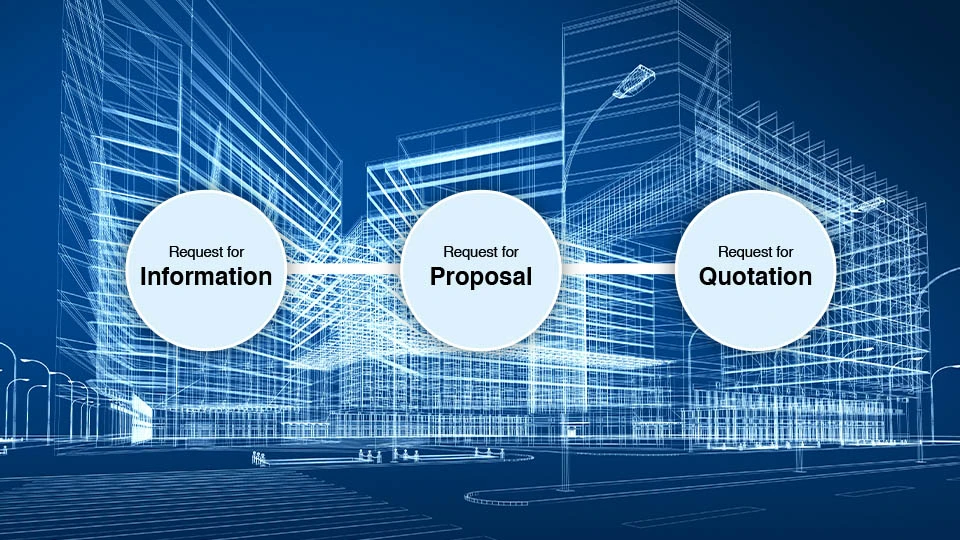
Each of these three request types form the core of any structured procurement journey:
- Request for Information (RFI): Issued during the earliest stage of procurement to gather insights, explore emerging technologies, and identify potential partners or vendors. An RFI is deliberately exploratory and non-binding, helping buyers understand what’s possible in the current market.
- Request for Proposal (RFP): Issued when project requirements and objectives are defined, but multiple approaches (broad technologies, implementation methodologies, support strategies, etc.) may exist. The RFP outlines goals and constraints and invites vendors to submit proposals that describe methods, tools, services, timelines, and support models. You’re asking not just what they deliver, but how they’ll deliver it.
- Request for Quotation (RFQ): Issued at the final stage, once specifications are clear and very focused. An RFQ focuses on pricing, contract terms, and specific delivery timelines for the defined scope of work.
Think of these procurement documents like steps in a relationship:
- The RFI is the first introduction—an opportunity to explore what's out there.
- The RFP is the stage where both sides get to know each other and evaluate long-term compatibility.
- The RFQ is the formal proposal, signaling readiness to move forward with a firm commitment.
But just like in relationships, timing and clarity are everything. Using the wrong document at the wrong stage can lead to mismatched expectations—issuing an RFP before defining outcomes clearly or requesting pricing before integration requirements are clear. That’s why understanding the intent and ideal timing of each request type is so important—misalignment leads to confusion, missed opportunities, or costly missteps.
You need this kind of clarity because if you issue an RFP when you're still exploring, vendors may over-engineer solutions or inflate costs. If you issue an RFQ before your scope is fully defined, you risk selecting the lowest bidder instead of the best-fit partner.
Smart Buildings Demand Smart Procurement
Smart buildings are no longer “bolt-on tech” layered on top of construction projects. Smart functionality is now foundational to a building’s entire lifecycle—from energy performance to tenant engagement.
As legal experts at Corrs Chambers Westgarth explain in their report Technology Procurement Challenges for Smart Building Developers and Operators:
“The lifecycle of technology differs materially from that of physical infrastructure. This raises challenges when procuring smart buildings under traditional construction contracts that are not designed for iterative development or future-proofing digital systems.”
This disconnect is compounded by the fact that smart buildings sit at the intersection of construction, IT, and operational technology—requiring procurement practices that go beyond traditional timelines. Yet many tenders still mirror legacy construction schedules, causing digital requirements to emerge too late.
Over the past decade—with noticeable acceleration in recent years—the buying cycle has matured. Buyers now demand interoperability, user-friendly design, and clear data ownership terms. RFQs increasingly reflect defined use cases and semantic interoperability instead of checklist specifications.
As Chris Bromley, Sales Director at Mitsubishi Electric Iconics Digital Solutions, observes, “I’ve never seen this level of inbound RFI and RFP activity in my decade in smart buildings. It’s not just more volume—it’s smarter questions.”
Evolving Priorities in Post-Pandemic Commercial Real Estate
Projects that were put on hold during the COVID-19 pandemic are now moving forward—but with a new set of expectations. The role of the office has changed. Owners are rightsizing portfolios, rethinking workplace technology, and prioritizing platforms that deliver measurable, data-driven ROI.
Functionality, once limited to consumer apps like seamless integrations and intuitive user interfaces, is increasingly expected in commercial systems. Today’s procurement teams ask detailed questions such as: How do the apps interface across platforms? How easily does data flow between systems? Does the UI work for both technical and non-technical users?
In parallel, procurement behavior has matured significantly:
- Buyers are more informed. They ask about open data models aligned to ontologies, protocol compatibility (and not just the traditional automation protocols, but BACnet/SC or MQTT), and long-term support strategies.
- RFQs are better organized. Clients are separating scopes—for example, distinguishing coupled hardware and software solutions (i.e., BMS) from middleware and cloud layers and APIs.
- Expectations for functionality have shifted. Consumer-grade usability and cross-platform interoperability are no longer optional—they’re foundational.
If your procurement process already reflects this level of clarity and rigor—well done. But if you’re unsure or see opportunities to refine your approach, the next section explores common pitfalls and how to avoid them.
Common Procurement Pitfalls in Smart Building Projects
Poorly scoped digital systems in the early stages of a project often lead to underperformance—especially when RFPs blur the line between system delivery and system integration.
To avoid this misstep, teams must recognize the most common procurement pitfalls—especially those that prevent smart building systems from working as a unified whole:
- Confusing System Delivery with System Integration: Supplying a lighting or HVAC system is not the same as integrating it with energy analytics, access control, or space-booking platforms. Without purposeful integration, even the best point solutions remain siloed, and the building never becomes truly smart.
- Bundling Everything Together: Combining hardware, software, and integration services in a single procurement lot makes it difficult to compare vendor strengths or assign accountability. Cost-driven selection then erodes long-term digital performance.
- Undefined Data Strategy: A procurement brief that omits data-flow diagrams, ownership rights, or security requirements leaves critical gaps. If a prospective vendor cannot clearly explain how data is stored, shared, and protected—or who ultimately owns it—consider that a red flag.
Each of these pitfalls traces back to one core issue: failing to define system integration as a distinct, strategic function. Without this clarity, scopes are often value-engineered, responsibility for user experience is unclear, and costly commissioning delays occur when systems don’t communicate as expected.
By identifying integration as its own deliverable—whether led by a master system integrator (MSI), a collaborative vendor team, or internal IT—buyers can reduce risk, maintain accountability, and set their projects up for long-term success.
Smart Procurement Strategies for Better Outcomes
The most successful smart building projects define digital requirements as early as RIBA Stage 0 or 1—the strategic definition and concept design phases outlined by the Royal Institute of British Architects (RIBA), which provides a standardized framework for project planning and delivery—long before commissioning begins.
Technology is not furniture that can be plugged in later; it shapes user experience and operational performance from day one. Yet many projects still treat smart systems as optional add-ons, loosely specified in generic contracts.
To realize the full value of your smart building investment:
- Procurement must evolve to support long-term outcomes, not just initial delivery
- Briefs must emphasize functionality, integration, and user journeys
- RFQs must be structured for accountability and meaningful vendor comparison
- Roles must be assigned to teams with the right expertise at the right time.
To put these principles into action, follow four foundational smart procurement strategies that improve clarity, accountability, and long-term outcomes:
1. Engage Early: Scope digital outcomes at RIBA Stage 0 or 1, not at hand-over. Early engagement ensures technology decisions support the overall design and lifecycle goals of the building.
2. Structure RFQs for Success: Break RFQs into distinct lots rather than bundling everything into one bid. Suggested lots are:
- Software platform
- MSI and data integration
- Building systems (lighting, HVAC, metering)
- Analytics and user experience
Separating lots simplifies vendor comparison, clarifies accountability, and protects long-term performance.
3. Clarify Roles: Clarify roles early to ensure each party contributes where it adds the most value. Suggested responsibilities include:
- Consultants add value by defining business goals, coordinating stakeholders, and framing the high-level vision.
- Software vendors and MSIs contribute technical depth—data modeling, integration workflows, and end-to-end functionality. Engaging each party at the right time prevents overlaps and gaps.
4. Own Your Digital Strategy: Smart-building delivery works best when owners stay actively involved. While partners can support execution, internal teams should define and own the digital roadmap—covering user experience, data flows, and long-term planning. Clear ownership ensures alignment with organizational goals and safeguards future scalability.
When these strategies are implemented early and thoughtfully, smart building projects are far more likely to achieve their intended outcomes—functionally, operationally, and financially.
Final Takeaways: Build Smart from the Start
Smart-building success doesn’t begin at commissioning—it starts with planning. The procurement process is the foundation. Get it right, and you set the stage for a seamless, future-ready deployment; get it wrong, and even the best technologies won’t reach full potential.
To maximize your success and ensure long-term performance, follow these strategic procurement best practices:
- Scope digital delivery at RIBA Stage 0 or 1. Don’t do this at hand-over.
- Own your digital roadmap. A building’s data strategy and user experience are too important to outsource completely.
- Invest time upfront to define requirements. Interoperability, open data, and lifecycle value should lead the list.
- Clarify roles early. Consultants guide strategy and stakeholder alignment, while vendors and MSIs provide technical execution.
- Engage strategic partners early. Shape the vision and system architecture up front—don’t just let vendors deliver against a spec.This approach ensures alignment across IT, facilities, and real estate teams from the start.
- Match the request to project readiness. Use RFIs for discovery; RFPs for evaluation; and RFQs for pricing once the scope is clear.
- Structure RFQs in modular lots. Separate software platforms, MSI and integration, building systems, analytics, or UX.
- Separate scopes. Integration is not the same as delivery—treat them as distinct workstreams.
- Avoid false economies. The lowest quote seldom delivers the smartest building. Choose partners who know the difference between a pilot and a portfolio rollout.
Smart buildings require smart procurement—anchored in clear intent, structured scope, and collaboration with the right partners at the right time.
Explore GENESIS for Smart Building Procurement to learn how our platform supports open integration, long-term scalability, and efficient delivery from day one.

Written By:
Recent Posts
How One Manufacturer Advanced Its Industrial Digital Transformation

Why Food & Beverage Manufacturers in APAC Are Rethinking Operations and Turning to Automation Platforms

If You’re Going to Invest in SCADA, Invest in Quality

Shifting the Focus in Industrial System Integration: Prioritizing Standards, Minimizing Tools, and Focusing on Process Expertise Over Multi-Vendor Tech Builds

How to Build a Best-in-Class Industrial Facility in a Multi-Vendor World